
State Street Investment Management (formerly State Street Global Advisors) has $5.66 trn in AUM (of which $3.59 trn is in equities), making it the fourth largest asset manager globally. It runs active to index strategies across all asset classes and employs over 500 portfolio managers, researchers and strategists, working in 10 investment centers and offices in 30 cities worldwide.
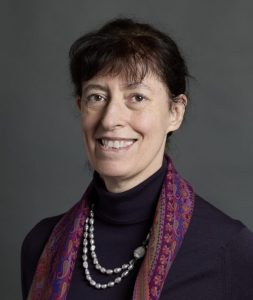 Esther Baroudy, managing director and senior portfolio manager in active fundamental equity, is based in State Street’s London office. She co-manages the Global Equity Select, Global Climate Transition and Global Sharia portfolios, working alongside her co-portfolio manager John Flynn, who also works as a senior portfolio manager in active fundamental equity.
Baroudy joined State Street Investment Management in 2016 through its acquisition of GE Asset Management, where she joined in 1996. She started her career at Credit Lyonnais Capital Markets in 1988.
She tells us more about current market volatility, State Street’s reputation for index investing and how AI is driving value in her portfolio.
Is it an interesting time to be a fund manager, given current geopolitics?
It’s very busy in terms of the market. It’s like a yo-yo at the moment. Yesterday, a huge rally and then today it’s quiet…
You’ve been in the industry since 1988. What’s changed for you in that time? The markets really changed in 2008, at the time of the global financial crisis. Since then, markets have become a lot more volatile and choppy, and you’ve got to really have nerves of steel to look through all this.
More recently, you’ve got digital investment platforms which are often heavily geared towards investment in tech. You can see financial players on X (formerly Twitter) and they suddenly have a wave of stocks that they’re really interested in, and these get driven up. Market players such as hedge funds see the flows. So it’s really changed in terms of the players. It can be fast moving and sometimes you feel the fundamentals are totally forgotten: it’s down to chasing a trend.
There have also been changes on the sell side. A lot of the senior analysts were let go to save cost because everything’s been commoditized and fees have come down. These days, I rely on our (in-house) analysts because obviously research is our biggest asset in the firm.
But now we’ve got AI, things are going to change dramatically again. For example, I can easily look up stocks, make a comparison and decide if I want to do more work on a name with our analysts.
What do you most like about the job?
If you have a winning portfolio against the market, that’s a really big high. Doing well for your clients, acting on behalf of thousands of people gives me a sense of purpose. You’ve got to find them the best possible investments for their retirement or healthcare, or whatever they need.
So, for me, that’s a big sense of why I do this. Plus, the team is so conscientious, everything is very carefully studied.
What do you dislike?
As above, I dislike the way that financial markets have become more ‘cowboy-style’, ‘anything goes, fundamentals forgotten’ and very short-term.
State Street is known for index investing, yet you look after some significant active funds?
That’s right. We have quite a big active team. These aren’t the only active strategies within State Street. In 2016, State Street acquired GE Asset Management and added an active manager by buying that firm.
State Street’s active equity strategies are probably underappreciated by some in the sector as our reputation is primarily as a huge passive or index investor.
Active management is a profitable activity and within State Street it’s a growth area, especially with retail customers. The percentage of active vs index might be small but many clients will have a core index exposure and then they might have some active equity around it.
State Street has an office in Dublin, do you collaborate with them?
Yes, we do a lot with our Active Fundamental Equity colleagues in Dublin and working as a truly global team helps us to deliver the best results for our clients.
Your investment style is durable growth, quality and reasonable valuation?
We’re looking for durable growth in earnings. So, say you’ve analysed that this corporate should be able to grow its earnings by 10 percent compounded over the next five years and that is the market consensus. If, after further study and due diligence, you believe that earnings growth can compound at 12 percent, not only will you be getting this 10 percent compounded return, you might get 12 percent. And when the market perceives it, it will generally re-rate that stock, enabling an even better return on the holding.
And the only way durable growth is sustained is because that corporate has a strong management strategy and a very strong market position where nobody else can come in and either take market share or force prices down. So, it’s not commoditized, it’s highly proprietary either in brand or IP. This is our definition of quality.
How do you work with John Flynn?
John and I have worked together on Global Equity Select since 2013. We make the big strategic moves together. We both keep a close eye on our strategies. We look at how the portfolio is moving relative to our analysts’ upgrades or downgrades of both earnings and confidence quotients, which is our measure of quality. If we feel a stock is getting out of line either on the upside or the downside – that is, if we feel it’s too cheap relative to the fundamentals – we’ll buy a bit more. If it’s too expensive, we trim.
We are only allowed to hold 30 to 40 names in a fund, so we have quite chunky positions relative to our benchmark.
What is the AUM of the three strategies you manage?
AUM can move in line with the market or to reflect where clients want to make their asset allocations. Clients’ portfolios are mirrored on our strategies. So, it’s almost like a model-
based approach. Portfolio weights depend on our confidence in the stock, or whether we’re building it up, etc. Timing is also very important.
Now we’ve got AI, things are going to change dramatically again A client may come in and say ‘I want to be exactly in line with Global Equity Select or I want to be exactly in line with the Global Equity Shariah’. Some clients will have a separately managed account where they have their own restrictions.
Do your colleagues ever join you in company meetings virtually?
Yes, colleagues often do. But I will also go to group meetings for the purpose of hearing what other people are asking.
What’s your market cap cut-off?
It’s $2 bn minimum.
What’s the geographic split of the strategy?
Currently, we’re very focused on the US so we are just ahead of our benchmark in terms of asset allocation (66.8 percent versus 63.1 percent in the MSCI ACWI benchmark, as of end of March 2026)
What’s the average holding period?
Three to five years, but some stocks we’ve held since I first started on the strategy.
And typical position size?
Between 2 percent and 7 percent.
Any sectors you avoid?
We don’t really avoid any particular sectors, but some sectors are cyclical and their earnings are less stable. The consumer staples sector was considered a very steady grower over time and that’s why it was once very highly rated. However, after the inflation due to the Ukraine war, the staples companies put up prices a lot and customers went elsewhere or just didn’t buy as much, so those names have derated.
The IT sector has become less cyclical. It used to bounce around a lot based on iPhone models coming out, etc., but now demand has really broadened out and its earnings are more stable.
You know what the demand is, you know who the suppliers are. So once the equity market is more secure about the prospects for a sector, they will rerate it. You want to be there before that happens.
Industrials used to be hostage to the capex cycle but now they are very much allied to AI: they are becoming less cyclical.
And do you use any screens?
Our analysts do and we have our own in-house screen based on our quality coefficients. We look at all the major variables: the leverage position, margins, cash flow, free cash flow yield, etc., but all these screens are backward-looking.
That’s why you want your analysts on board, you want everybody looking forward, everybody digging around. And now there’s so much information available in open source.
What’s the active share ratio?
It’s 85 percent, which is relatively high as we run a concentrated portfolio.
What about capital allocation? Do you prefer dividends or buybacks?
It depends on the company.
I know you can’t talk about individual holdings, but which themes are you focused on?
We are very, very focused on AI and all the drivers of AI. We look for innovative companies with proprietary IP. The industry is moving towards agentic AI and then the next step will be physical AI, which is robotics mainly. Humanoid robots will eventually be sent to difficult and dangerous places such as the Moon and deserts instead of humans. It’s a fast-changing world.